Birzeit Consulting is a professional services company providing an integrated spectrum of anti fraud / corruption and internal control advisory and training services.
From our regional office in Amman-Jordan, we serve our clients in the Middle East and Africa supported by our highly qualified teams, affiliates, representations and strategic alliances. We run our global business from our head office in Tempe,AZ, USA
Birzeit Consulting will be participating as a partner in the 4th Forensic Conference Fro Africa titled " Fighting Fraud / Corruption and Money Laundering in Africa Using Investigative Accounting Skills to enhance Operating efficiency" in Accra - Ghana during the period December 5 - 9, 2011. Birzeit Consulting will be participating by several of its associates and experts coming from the United States of America, the United Kingdom, and Jordan. The chief international speaker at the conference would be Mr. Mohammed J. Masoud, CPA, CFE, CICA, MBA, co-founder and managing director of Birzeit Consulting. He is an adjunct professor at the Arab American University, serves as an ACFE advisory board member, and a board member of the Arab Accountants Union (AAU) in Egypt. Participants will be from several African, Middle Eastern, and European countries. The guest of honor of the conference would be Mr. Adu Anane Antwi, BSc, LLB, MBA, CA, Director General of the Securities & Exchange Commission-Ghana. The conference detailed brochure and its condensed one can be found when you click on each of them. For registration, please contact O'Sullivan Associates Ltd, our partner in Kenya.
While the SEC moves toward a 2011 vote on whether to require U.S. public companies to report using IFRS, a more compact version of the international standards is already an option, subject to state board approval, for U.S. private companies. Now there’s a free online tool to help preparers understand how that streamlined standard compares to U.S. GAAP.
The IFRS for SMEs-U.S. GAAP Comparison Wiki, available at wiki.ifrs.com, is a collaborative resource launched in January for understanding differences between the two sets of financial reporting standards. IFRS for SMEs is a simplified version of full IFRS aimed at meeting the needs of private company financial reporting users. It eliminates some of the requirements meant specifically for public entities.
The Triangle of Truth
The most basic principle of project management is known technically as the triple constraint (also dubbed the “Triangle of Truth” by consultant Dave Franz).
What are you doing to grow your practice? How can you help your clients become more profitable? Use the following tips to redefine the services you provide clients, and look for additional opportunities to develop new revenue sources:
Conduct a self-assessment.Ask yourself what you are passionate about. Think about something you would secretly do for free and how to start getting paid for it. What’s stopping you from doing more of it? Are you not reaching the right audience? Are you not telling the people you know all the things you can do? Your clients may be seeking help from someone else for services that you could be providing.
Brand yourself.Define your role and how you relate to your clients. Are you a tax preparer? A problem-solver? Or a nagging parental figure constantly reminding clients to do their bank reconciliation?
Write an elevator speech and memorize it.What can you tell people in 15 to 30 seconds that lets them know your specific talents and would make them interested in finding out more? What sets you apart from your competitors? Make it unique, not boring. Create a few sentences that, when spoken, leave the listener asking for more. One technology consultant testing her pitch said, “I’m a geek. I break software. I test it to see where it doesn’t work and then find what works for your company.”
Address your clients’ pain points.Think about ways to woo existing clients by first listening to the problem, and then repeating it back to them and telling them how you can solve it. Provide them with best practices you’ve observed in their industry. Articulate value and show tangible results using benefit statements such as, “After we work together, you will be able to use your financial statements to make better management decisions,” or “You can feel confident that I’ll be able to help you increase your profits by 10% or more.”
Create a simplified one-page strategic plan.Concentrate on defining core values, setting short-term, mid-term and long-term goals and metrics. Set specific targets: If you want more business, does that mean a specific number of new clients or a specific dollar amount of increased revenue? Make these targets objective. Then write an action plan, implement it, and review and revise as necessary.
Help clients rethink their business.Once you’ve designed your own strategic plan, use it to offer business planning services to clients. Ask them what two or three metrics they use to manage their business. If they can’t answer you, offer to help them create those metrics. Ask them how many months’ operating expenses they have in reserve. Are they content with their current pricing strategy? How do they determine whether they have the correct staffing levels? Do they know the optimum revenue each employee should be generating? Do they have an exit strategy? Are they looking at creating an ESOP for their employees? Use terms that will sound interesting to your clients, not just to you. Talk about “financial management” instead of “accounting.”
Ask for referrals, and highlight testimonials.The majority of your business comes through referrals, but are you actively pursuing referrals? Make it a goal to call a certain number of clients each month and ask whether they know someone who might benefit from your services. If they thank you in an e-mail or even verbally, ask them if you can use it as a client testimonial on your Web site.
Charge by packages, not by the hour.The only way to make more money as an hourly consultant is to raise prices or work more hours. With package (or fee-based) pricing, as you get more efficient, you make more money (see “Pricing on Purpose: How to Implement Value Pricing in Your Firm,” JofA, June 09, page 62).
—By Alexandra DeFelice (adefelice@aicpa.org), a JofA senior editor, based on a presentation by Leslie Shiner, MBA, (lshiner@shinergroup.com) financial and management consultant and owner of San Francisco-based The ShinerGroup.
Previous attempts by Rea & Associates to develop consistent procedures didn’t always result in the most successful, efficient or effective processes. Instead, 11 offices did things 11 ways because they didn’t buy into the need for consistency in its processes. With Lean Six Sigma, the firm adopted a one-firm concept where returns would be consistently produced, while still allowing some flexibility to address staffing, structural or other nuances among the various offices. For example, some larger offices have multiple administrative staff at the end of the process while smaller offices have only one person. The end process accommodates for these staffing differences. Also, the firm developed tools called “Quick Checks”, designed to double check for common mistakes that were frequently being detected during the review process. These could be modified by office location.
We took a global look at our business tax return process, not just the preparation stage or the review stage. Using a cross functional team comprised of representatives from all levels within the organization (from Administration to Staff Accountants to Senior Managers to a Partner), the project analyzed everything from how client information was requested and received to how returns were prepared and reviewed to how they were processed, assembled and filed. Staff input was considered before the rollout began. The focus was on providing better client satisfaction at each step along the way in order to provide higher overall value.
The following are specific steps, common among many accounting firms, that Rea & Associates implemented to improve processes.
Manage the Front Door. A business client request list was revamped and a systematic process developed for receiving as much client data as possible at the first visit. The goal was to work on this initial phase in advance of busy season. The process is customizable for every client—by using names and terminology familiar to the client, it makes the information-gathering process much quicker and easier.
Maximize Workflow. Efficiency was improved by adopting common organizational standards for every workstation. For example, each desk is organized consistently so that the next person in the process knows exactly where to find or place hardcopy or electronic tax client information. The physical layout of all work areas within a building is organized for maximum efficiency—accomplished through uniform electronic and workspace organization techniques.
Reduce Bottlenecks. Time goals were developed and processes implemented to shorten cycle times. Care is taken to align the right people to the right level of work to alleviate bottlenecks. Process champions continually identify uneven flow and work together across the firm to reallocate resources and better serve clients.
Streamline Assembly. The needs of processing and assembly personnel were identified, resulting in reduced questions and rework.
Renewed focus on efficiency and quality can beef up profitability.
By DUSTIN HOSTETLER
JANUARY 2010
Poor processes directly affect client service and client satisfaction. You see it in delays in completing jobs, responding to client requests, or when a partner fails to communicate a piece of client-related information, causing an unnecessary mistake down the line. Inefficient processes can result in your firm’s inability to bill for all the work in process, which decreases profitability. If your firm has experienced any of these problems, it is a sign of inefficient work processes that are keeping you from maximizing talents and resources. Lean Six Sigma, a method often used by manufacturers to improve internal processes, can improve your firm’s business operations while driving short- and long-term benefits to the bottom line.
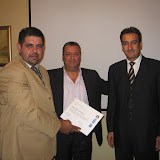
Mr. Mahmoud Nofal (middle); the Director General of the Property Tax; MoF-PNA; MR Sakher Al Ahmed, the UNDP representative (left); Dr. Mohammed Masoud ,(right), the Managing Director of Birzeit Consulting ME. Click here to see the certificate of completion delivery / ceremony
The ACFE's 2010 Report to the Nations on Occupational Fraud and Abuse is based on data compiled from a study of 1,843 cases of occupational fraud that occurred worldwide between January 2008 and December 2009. All information was provided by the Certified Fraud Examiners (CFEs) who investigated those cases. The fraud cases in our study came from 106 nations — with more than 40% of cases occurring in countries outside the United States — providing a truly global view into the plague of occupational fraud.
Since the inception of the Report to the Nation more than a decade ago, we have released five updated editions — in 2002, 2004, 2006, 2008 and the current version in 2010. Like the first Report, each subsequent edition has been based on detailed case information provided by Certified Fraud Examiners (CFEs). With each new edition of the Report, we add to and modify the questions we ask of our survey participants in order to enhance the quality of the data we collect. This evolution of the Report to the Nation has enabled us to continue to draw more meaningful information from the experiences of CFEs and the frauds they encounter.
In our 2010 Report, we have, for the first time ever, widened our study to include cases from countries outside the United States. This expansion allows us to more fully explore the truly global nature of occupational fraud and provides an enhanced view into the severity and impact of these crimes. Additionally, we are able to compare the anti-fraud measures taken by organizations worldwide in order to give fraud fighters everywhere the most applicable and useful information to help them in their fraud prevention and detection efforts. Excerpt from the Report's "Letter from the President," by James D. Ratley, CFE:
"On behalf of the ACFE, and in honor of its founder, Dr. Joseph T. Wells, CFE, CPA, I am pleased to present the 2010 Report to the Nations on Occupational Fraud and Abuse to practitioners, business and government organizations, academics, the media and the general public throughout the world. The information contained in this Report will be invaluable to those who seek to deter, detect, prevent or simply understand the global economic impact of occupational fraud."
The wise man will never imagine or believe that knowledge is limited or can be hidden from others. What you know today will or may be obsolete immediately!


 Conduct a self-assessment.
 Excerpt from the Report's "Letter from the President," by James D. Ratley, CFE: