Birzeit Consulting is a professional services company providing an integrated spectrum of anti fraud / corruption and internal control advisory and training services.
From our regional office in Amman-Jordan, we serve our clients in the Middle East and Africa supported by our highly qualified teams, affiliates, representations and strategic alliances. We run our global business from our head office in Tempe,AZ, USA
Senior executives expect fraud to pose a significant challenge over the next 12 months, according to KPMG Forensic’s recently released Fraud Survey 2009. Nearly one-third (32%) of the senior executives surveyed said they expect some form of fraud or misconduct to increase in their organizations. A majority (65%) said that fraud and misconduct poses a significant risk to their industry today.
What is their greatest concern if such wrongdoing is experienced? More than 70% were concerned with the potential loss of public trust at a time when market confidence is at a premium.
Also, 66% of the executives reported that inadequate internal controls or compliance programs at their organizations enable fraud and misconduct to go unchecked, and they identified the following areas in need of the most improvements in antifraud efforts: employee communication and training (67%), technology-driven continuous auditing and monitoring techniques (65%), and fraud and misconduct risk assessment (60%).
The Committee of Sponsoring Organizations of the Treadway Commission (COSO) released a thought paper, Strengthening Enterprise Risk Management for Strategic Advantage, that highlights specific areas where senior management can work with directors to enhance the board’s risk oversight capabilities and the organization’s strategic value. This document builds on four specific board risk oversight responsibilities outlined in another COSO thought paper, Effective Enterprise Risk Oversight: The Role of the Board of Directors, that was released Sept. 1 to provide more detail on ways senior management can work with the board and others in the organization to strengthen risk management in all types of organizations. Both thought papers can be downloaded for free at coso.org.
Renewed focus on efficiency and quality can beef up profitability.
By DUSTIN HOSTETLER
JANUARY 2010
Poor processes directly affect client service and client satisfaction. You see it in delays in completing jobs, responding to client requests, or when a partner fails to communicate a piece of client-related information, causing an unnecessary mistake down the line. Inefficient processes can result in your firm’s inability to bill for all the work in process, which decreases profitability. If your firm has experienced any of these problems, it is a sign of inefficient work processes that are keeping you from maximizing talents and resources. Lean Six Sigma, a method often used by manufacturers to improve internal processes, can improve your firm’s business operations while driving short- and long-term benefits to the bottom line.
The aim of the risk assessment auditing standards was to improve the quality and effectiveness of audits by substantially changing audit practice. Statements on Auditing Standards nos. 104–111 provide increased rigor to the audit process in a number of key areas including the assessments of inherent and control risks and the linking of these risk assessments to further audit procedures.
This year marks the third anniversary of the standards’ effective date. Across the profession much progress has been made toward the ultimate goal of a more reliable audit process, but even more is possible as we continue to learn about the standards’ practical application.
This article captures some of the most important lessons learned and best practices that have emerged during the extended implementation of the risk assessment standards (see sidebar, “Methodology Behind Application Suggestions,” at bottom of page).
IMPLEMENTATION ISSUE NO. 1: EVALUATING INTERNAL CONTROL
Healthy doses of skepticism and due care can help uncover schemes to inflate sales.
By JOHN F. MONHEMIUS, CPA AND KEVIN P. DURKIN, CPA
DECEMBER 2009
Following an initial customer confirmation request with no response, a first-year auditor mails a second and third request, all under the supervision of the auditor-in-charge assigned to the account. Field work begins on the audit, but there is still no response from the customer. Another auditor scanning the cash journal from the beginning of the year through the current date notes that all outstanding invoices have subsequently been paid from this customer during this period. Customer check copies are provided, and remittances indicate that payment has been received in settlement of all outstanding invoices at fiscal year-end for this customer. But has the existence of accounts receivable from this customer at fiscal year-end really been established?
Fraudsters have been creating increasingly complex and sophisticated schemes designed to rely on potential weaknesses in the execution of audit procedures surrounding key assertions such as existence. A financial statement auditor can use his or her professional judgment while carrying out audit procedures to detect such a scheme.
In July 2009, the International Accounting Standards Board (IASB) released International Financial Reporting Standards designed for use by small and medium-sized entities (SMEs).
IFRS for SMEs is a self-contained, standalone set of financial accounting and reporting standards. Along with the standards, the board released implementation guidance, such as example financial statements and disclosure checklists. The board is also developing training materials for IFRS for SMEs.
At approximately 230 pages, IFRS for SMEs is a simplified version of full IFRS.
The body of risk management knowledge includes many other sources, including lectures and books from recognized thought leaders, such as Robert Shiller, Nassim Taleb and others; at least 15 professional risk-related organizations such as the Casualty Actuarial Society, the Federation of European Risk Management Associations, the Global Association of Risk Professionals, and the Institute of Internal Auditors; and at least 15 other risk-related frameworks, including ISO 31000 and AS/NZS (Australian/New Zealand standard) 4360:2004. The authors suggest a COSO-driven risk management process without any regard for this body of knowledge. Why?
These are some of the problems with the COSO ERM Framework:
The Committee of Sponsoring Organizations of the Treadway Commission (COSO) published a document to help boards of directors strengthen their oversight of enterprise risks.
The four-page paper, Effective Enterprise Risk Oversight: The Role of the Board of Directors, calls attention to COSO’s Enterprise Risk Management—Integrated Framework (2004) and its definition of ERM.
In emphasizing the critical role boards of directors play in overseeing ERM, it points to the following areas discussed in COSO’s 2004 ERM framework that contribute to board risk oversight:
Understand the entity’s risk philosophy and concur with the entity’s risk appetite.
Know the extent to which management has established effective enterprise risk management of the organization.
Review the entity’s portfolio of risk and consider it against the entity’s risk appetite.
Be apprised of the most significant risks and whether management is responding appropriately.
By Thomas A. Ratcliffe, CPA, and Charles E. Landes, CPA
September 2009
This white paper written by Thomas A. Ratcliffe and Charles E. Landes and prepared by the AICPA Audit and Attestation Standards and Professional Publications teams seeks to clear up confusion among practitioners relating to the concept of internal control over financial reporting. It describes the concepts of internal control (specifically internal control over financial reporting) and discusses the types of services related to internal control that may be performed by practitioners in public practice. To download the paper in PDF format, click here.
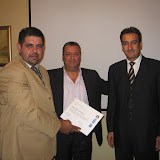
Mr. Mahmoud Nofal (middle); the Director General of the Property Tax; MoF-PNA; MR Sakher Al Ahmed, the UNDP representative (left); Dr. Mohammed Masoud ,(right), the Managing Director of Birzeit Consulting ME. Click here to see the certificate of completion delivery / ceremony
Revenue recognition among proposals released as FASB, IASB commit to new timeline.FASB and the IASB wrapped up the first of three rounds of issuing proposed standards in their final push toward U.S. GAAP-IFRS convergence, even as they gave themselves an extra six months to complete the ambitious project.
كثيرا ما أستمع في جلسات مهنية محلية ودولية مصطلح "الحكم المهني للمدقق" عند الحديث عن أعمال التدقيق لمدقق الحسابات المستقل. وقد لاحظت في أحيان كثيرة بأن هذا المصطلح يستخدم في غير محله ، وأحيانا دون وضوح تام حول طبيعة هذا المصطلح، الغرض من إستخدامه، شروط إستخدامه وطبيعة توثيقه في أوراق العمل. بالإضافة إلى الأثر الجوهري على نوعية أعمال التدقيق والنتائج المترتبة على ذلك.
The ACFE's 2010 Report to the Nations on Occupational Fraud and Abuse is based on data compiled from a study of 1,843 cases of occupational fraud that occurred worldwide between January 2008 and December 2009. All information was provided by the Certified Fraud Examiners (CFEs) who investigated those cases. The fraud cases in our study came from 106 nations — with more than 40% of cases occurring in countries outside the United States — providing a truly global view into the plague of occupational fraud.
Since the inception of the Report to the Nation more than a decade ago, we have released five updated editions — in 2002, 2004, 2006, 2008 and the current version in 2010. Like the first Report, each subsequent edition has been based on detailed case information provided by Certified Fraud Examiners (CFEs). With each new edition of the Report, we add to and modify the questions we ask of our survey participants in order to enhance the quality of the data we collect. This evolution of the Report to the Nation has enabled us to continue to draw more meaningful information from the experiences of CFEs and the frauds they encounter.
In our 2010 Report, we have, for the first time ever, widened our study to include cases from countries outside the United States. This expansion allows us to more fully explore the truly global nature of occupational fraud and provides an enhanced view into the severity and impact of these crimes. Additionally, we are able to compare the anti-fraud measures taken by organizations worldwide in order to give fraud fighters everywhere the most applicable and useful information to help them in their fraud prevention and detection efforts. Excerpt from the Report's "Letter from the President," by James D. Ratley, CFE:
"On behalf of the ACFE, and in honor of its founder, Dr. Joseph T. Wells, CFE, CPA, I am pleased to present the 2010 Report to the Nations on Occupational Fraud and Abuse to practitioners, business and government organizations, academics, the media and the general public throughout the world. The information contained in this Report will be invaluable to those who seek to deter, detect, prevent or simply understand the global economic impact of occupational fraud."


 Excerpt from the Report's "Letter from the President," by James D. Ratley, CFE: