Thursday, September 09, 2010

Get Results: Specific Steps to Process Improvement

By DUSTIN HOSTETLER
JANUARY 2010

Editor's note: This is a Web-exclusive sidebar for "Get Results: Improve Your Accounting Firm Processes Using Lean Six Sigma," Jan. 10.
Previous attempts by Rea & Associates to develop consistent procedures didn’t always result in the most successful, efficient or effective processes. Instead, 11 offices did things 11 ways because they didn’t buy into the need for consistency in its processes. With Lean Six Sigma, the firm adopted a one-firm concept where returns would be consistently produced, while still allowing some flexibility to address staffing, structural or other nuances among the various offices. For example, some larger offices have multiple administrative staff at the end of the process while smaller offices have only one person. The end process accommodates for these staffing differences. Also, the firm developed tools called “Quick Checks”, designed to double check for common mistakes that were frequently being detected during the review process. These could be modified by office location.
We took a global look at our business tax return process, not just the preparation stage or the review stage. Using a cross functional team comprised of representatives from all levels within the organization (from Administration to Staff Accountants to Senior Managers to a Partner), the project analyzed everything from how client information was requested and received to how returns were prepared and reviewed to how they were processed, assembled and filed. Staff input was considered before the rollout began. The focus was on providing better client satisfaction at each step along the way in order to provide higher overall value.
The following are specific steps, common among many accounting firms, that Rea & Associates implemented to improve processes.
Manage the Front Door. A business client request list was revamped and a systematic process developed for receiving as much client data as possible at the first visit. The goal was to work on this initial phase in advance of busy season. The process is customizable for every client—by using names and terminology familiar to the client, it makes the information-gathering process much quicker and easier.
Maximize Workflow. Efficiency was improved by adopting common organizational standards for every workstation. For example, each desk is organized consistently so that the next person in the process knows exactly where to find or place hardcopy or electronic tax client information. The physical layout of all work areas within a building is organized for maximum efficiency—accomplished through uniform electronic and workspace organization techniques.
Reduce Bottlenecks. Time goals were developed and processes implemented to shorten cycle times. Care is taken to align the right people to the right level of work to alleviate bottlenecks. Process champions continually identify uneven flow and work together across the firm to reallocate resources and better serve clients.
Streamline Assembly. The needs of processing and assembly personnel were identified, resulting in reduced questions and rework.

What's New for CPAs in Office 2010

By RANDY JOHNSTON
FEBRUARY 2010
Office 2010
Microsoft has updated one of the most important tools in the accountant’s tool kit, Microsoft Office. This article describes the features in the new versions of Excel, Word, Access, PowerPoint and Outlook that are likely to be most important to CPAs when Office 2010 is released in June.
Each module of Office 2010 has received updates to features and improved ease of use. Although many of the changes from Office 2007 are subtle, the theme is one of easier access to many common functions—with buttons consolidated into single menus and the number of steps necessary to accomplish certain tasks greatly reduced, improving productivity. If you don’t want to wait for the retail release to try out the new features, a fully functioning beta version of the software is available free from Microsoft at microsoft.com/office/2010.
This article is based on the technical preview version of Office 2010, which Microsoft provided before the public beta version was released. Although the final retail version is expected to be substantially similar to the technical preview version, keep in mind that Microsoft might make minor changes to the software before the official release date.


AICPA Issues Guidance on Subsequent Events

JAN. 12, 2010

New guidance is available on the effect of FASB’s Accounting Standards Codification Topic 855, Subsequent Events, in compilation and review engagements.
The AICPA’s Audit and Attest Standards Team issued a new Technical Inquiry and Reply (TPA) 9150.26, “The Accountant’s Responsibilities for Subsequent Events in Compilation and Review Engagements.”
According to the TPA, FASB ASC 855, Subsequent Events, does not change the accountant’s responsibilities under AR section 100, Compilation and Review of Financial Statements (AICPA, Professional Standards, vol. 2), which states that an accountant performing a review engagement should inquire of members of management who have responsibility for financial and accounting matters concerning events subsequent to the date of the financial statements that could have a material effect on the financial statements.
In a compilation engagement, the accountant has no responsibility with respect to subsequent events unless he or she learns of evidence or information that a subsequent event that has a material effect on the financial statements has occurred.
When such evidence or information comes to an accountant’s attention during a compilation or review engagement, he or she should request that management consider the possible effects on the financial statements, including the adequacy of any related disclosure. If the accountant determines that a subsequent event is not appropriately accounted for in the financial statements or disclosed in the notes, he or she should follow the guidance in paragraphs .56–.58 of AR section 100 regarding departures from generally accepted accounting principles, the TPA states.
For more, see the full technical practice aid.

Fraud Risk Expected to Rise

JANUARY 2010

Senior executives expect fraud to pose a significant challenge over the next 12 months, according to KPMG Forensic’s recently released Fraud Survey 2009. Nearly one-third (32%) of the senior executives surveyed said they expect some form of fraud or misconduct to increase in their organizations. A majority (65%) said that fraud and misconduct poses a significant risk to their industry today.
What is their greatest concern if such wrongdoing is experienced? More than 70% were concerned with the potential loss of public trust at a time when market confidence is at a premium.
Also, 66% of the executives reported that inadequate internal controls or compliance programs at their organizations enable fraud and misconduct to go unchecked, and they identified the following areas in need of the most improvements in antifraud efforts: employee communication and training (67%), technology-driven continuous auditing and monitoring techniques (65%), and fraud and misconduct risk assessment (60%).

Enterprise Risk Management

JANUARY 2010

The Committee of Sponsoring Organizations of the Treadway Commission (COSO) released a thought paper, Strengthening Enterprise Risk Management for Strategic Advantage, that highlights specific areas where senior management can work with directors to enhance the board’s risk oversight capabilities and the organization’s strategic value. This document builds on four specific board risk oversight responsibilities outlined in another COSO thought paper, Effective Enterprise Risk Oversight: The Role of the Board of Directors, that was released Sept. 1 to provide more detail on ways senior management can work with the board and others in the organization to strengthen risk management in all types of organizations. Both thought papers can be downloaded for free at coso.org.

Get Results: Improve Your Accounting Firm Processes Using Lean Six Sigma

Renewed focus on efficiency and quality can beef up profitability.

By DUSTIN HOSTETLER
Lean Six SigmaJANUARY 2010

Poor processes directly affect client service and client satisfaction. You see it in delays in completing jobs, responding to client requests, or when a partner fails to communicate a piece of client-related information, causing an unnecessary mistake down the line. Inefficient processes can result in your firm’s inability to bill for all the work in process, which decreases profitability. If your firm has experienced any of these problems, it is a sign of inefficient work processes that are keeping you from maximizing talents and resources. Lean Six Sigma, a method often used by manufacturers to improve internal processes, can improve your firm’s business operations while driving short- and long-term benefits to the bottom line.


Risk-Based Audit Best Practices

By MICHAEL RAMOS, CPA
DECEMBER 2009
Risk-Based Audit Best Practices
The aim of the risk assessment auditing standards was to improve the quality and effectiveness of audits by substantially changing audit practice. Statements on Auditing Standards nos. 104–111 provide increased rigor to the audit process in a number of key areas including the assessments of inherent and control risks and the linking of these risk assessments to further audit procedures.
This year marks the third anniversary of the standards’ effective date. Across the profession much progress has been made toward the ultimate goal of a more reliable audit process, but even more is possible as we continue to learn about the standards’ practical application.
This article captures some of the most important lessons learned and best practices that have emerged during the extended implementation of the risk assessment standards (see sidebar, “Methodology Behind Application Suggestions,” at bottom of page).

IMPLEMENTATION ISSUE NO. 1: EVALUATING INTERNAL CONTROL


Detecting Circular Cash Flow

Healthy doses of skepticism and due care can help uncover schemes to inflate sales.

By JOHN F. MONHEMIUS, CPA AND KEVIN P. DURKIN, CPA
DECEMBER 2009
Circular Cash Flow
Following an initial customer confirmation request with no response, a first-year auditor mails a second and third request, all under the supervision of the auditor-in-charge assigned to the account. Field work begins on the audit, but there is still no response from the customer. Another auditor scanning the cash journal from the beginning of the year through the current date notes that all outstanding invoices have subsequently been paid from this customer during this period. Customer check copies are provided, and remittances indicate that payment has been received in settlement of all outstanding invoices at fiscal year-end for this customer. But has the existence of accounts receivable from this customer at fiscal year-end really been established?
Fraudsters have been creating increasingly complex and sophisticated schemes designed to rely on potential weaknesses in the execution of audit procedures surrounding key assertions such as existence. A financial statement auditor can use his or her professional judgment while carrying out audit procedures to detect such a scheme.

IFRS for SMEs: The Next Standard for U.S. Private Companies?

By MARK FITZPATRICK, CPA and FRED FRANK, CPA
DECEMBER 2009
IFRS for SMEs
In July 2009, the International Accounting Standards Board (IASB) released International Financial Reporting Standards designed for use by small and medium-sized entities (SMEs).
IFRS for SMEs is a self-contained, standalone set of financial accounting and reporting standards. Along with the standards, the board released implementation guidance, such as example financial statements and disclosure checklists. The board is also developing training materials for IFRS for SMEs.
At approximately 230 pages, IFRS for SMEs is a simplified version of full IFRS.


More to Risk Management Than COSO ERM

By Arnold H. Schanfield, CPA, CIA, CFE
DECEMBER 2009

The authors of “ERM: Opportunities for Improvement” (Sept. 09, page 28) only discuss/reference the COSO ERM Framework.
The body of risk management knowledge includes many other sources, including lectures and books from recognized thought leaders, such as Robert Shiller, Nassim Taleb and others; at least 15 professional risk-related organizations such as the Casualty Actuarial Society, the Federation of European Risk Management Associations, the Global Association of Risk Professionals, and the Institute of Internal Auditors; and at least 15 other risk-related frameworks, including ISO 31000 and AS/NZS (Australian/New Zealand standard) 4360:2004. The authors suggest a COSO-driven risk management process without any regard for this body of knowledge. Why?
These are some of the problems with the COSO ERM Framework:

Enterprise Risk Management

NOVEMBER 2009

The Committee of Sponsoring Organizations of the Treadway Commission (COSO) published a document to help boards of directors strengthen their oversight of enterprise risks.
The four-page paper, Effective Enterprise Risk Oversight: The Role of the Board of Directors, calls attention to COSO’s Enterprise Risk Management—Integrated Framework (2004) and its definition of ERM.
In emphasizing the critical role boards of directors play in overseeing ERM, it points to the following areas discussed in COSO’s 2004 ERM framework that contribute to board risk oversight:

  • Understand the entity’s risk philosophy and concur with the entity’s risk appetite.

  • Know the extent to which management has established effective enterprise risk management of the organization.

  • Review the entity’s portfolio of risk and consider it against the entity’s risk appetite.

  • Be apprised of the most significant risks and whether management is responding appropriately.
The paper can be downloaded at coso.org.

White Paper: Understanding Internal Control and Internal Control Services

White Paper: Understanding Internal Control and Internal Control Services

By Thomas A. Ratcliffe, CPA, and Charles E. Landes, CPA
September 2009

This white paper written by Thomas A. Ratcliffe and Charles E. Landes and prepared by the AICPA Audit and Attestation Standards and Professional Publications teams seeks to clear up confusion among practitioners relating to the concept of internal control over financial reporting. It describes the concepts of internal control (specifically internal control over financial reporting) and discusses the types of services related to internal control that may be performed by practitioners in public practice.
To download the paper in PDF format, click here.


Assessing the Allowance for Doubtful Accounts

Assessing the Allowance for Doubtful Accounts

Using historical data to evaluate the estimation process

By MARK E. RILEY, CPA, PH.D. and WILLIAM R. PASEWARK, CPA, PH.D.
SEPTEMBER 2009


Friday, August 06, 2010

"Principles of Property Tax Assessment and Anti Fraud" Workshop for the Property Tax Department of the MoF-PNA

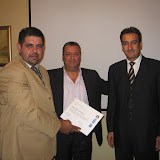
Mr. Mahmoud Nofal (middle); the Director General of the Property Tax; MoF-PNA; MR Sakher Al Ahmed, the UNDP representative (left); Dr. Mohammed Masoud ,(right), the Managing  Director of Birzeit Consulting ME. Click here to see the certificate of completion delivery / ceremony


Convergence Milestone

Revenue recognition among proposals released as FASB, IASB commit to new timeline.FASB and the IASB wrapped up the first of three rounds of issuing proposed standards in their final push toward U.S. GAAP-IFRS convergence, even as they gave themselves an extra six months to complete the ambitious project.